8GB vs 12GB RAM: Find out which smartphone RAM option is better in 2026 for gaming, multitasking, AI, battery life, everyday use and long-term performance.
8GB vs 12GB RAM: Does More RAM Really Matter in 2026?
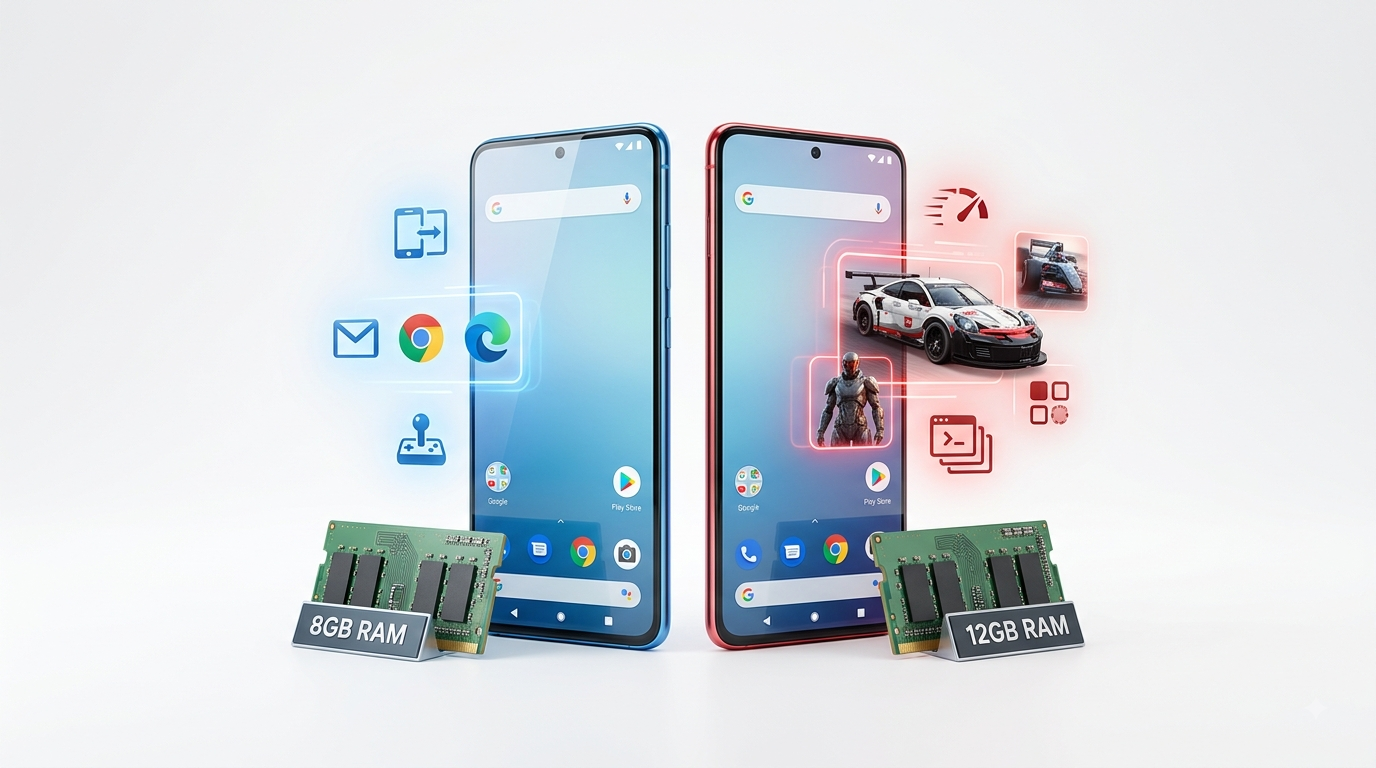
When people buy a new smartphone, RAM is one of the specifications they usually check before making a decision. You will often see phones advertised with 8GB, 12GB or even higher RAM configurations, with manufacturers presenting more RAM as a sign of better performance.
But does having 12GB RAM actually make a phone faster than an 8GB model?
The short answer is: sometimes, but not always.
For everyday smartphone users, the difference between 8GB and 12GB RAM may be much smaller than the numbers suggest. On the other hand, people who play demanding games, edit videos, use multiple apps simultaneously or plan to keep their phone for several years may benefit from having additional memory.
Android's memory management also makes the situation more complicated. The operating system intentionally uses available RAM for active and cached processes so apps can be reopened quickly. Therefore, seeing a phone using most of its RAM does not necessarily mean that the device is running out of memory.
So, should you buy an 8GB RAM phone or a 12GB RAM phone in 2026?
Let's look at the differences in detail.
Meta Description:
8GB vs 12GB RAM: Find out which smartphone RAM option is better in 2026 for gaming, multitasking, AI, battery life, everyday use and long-term performance.
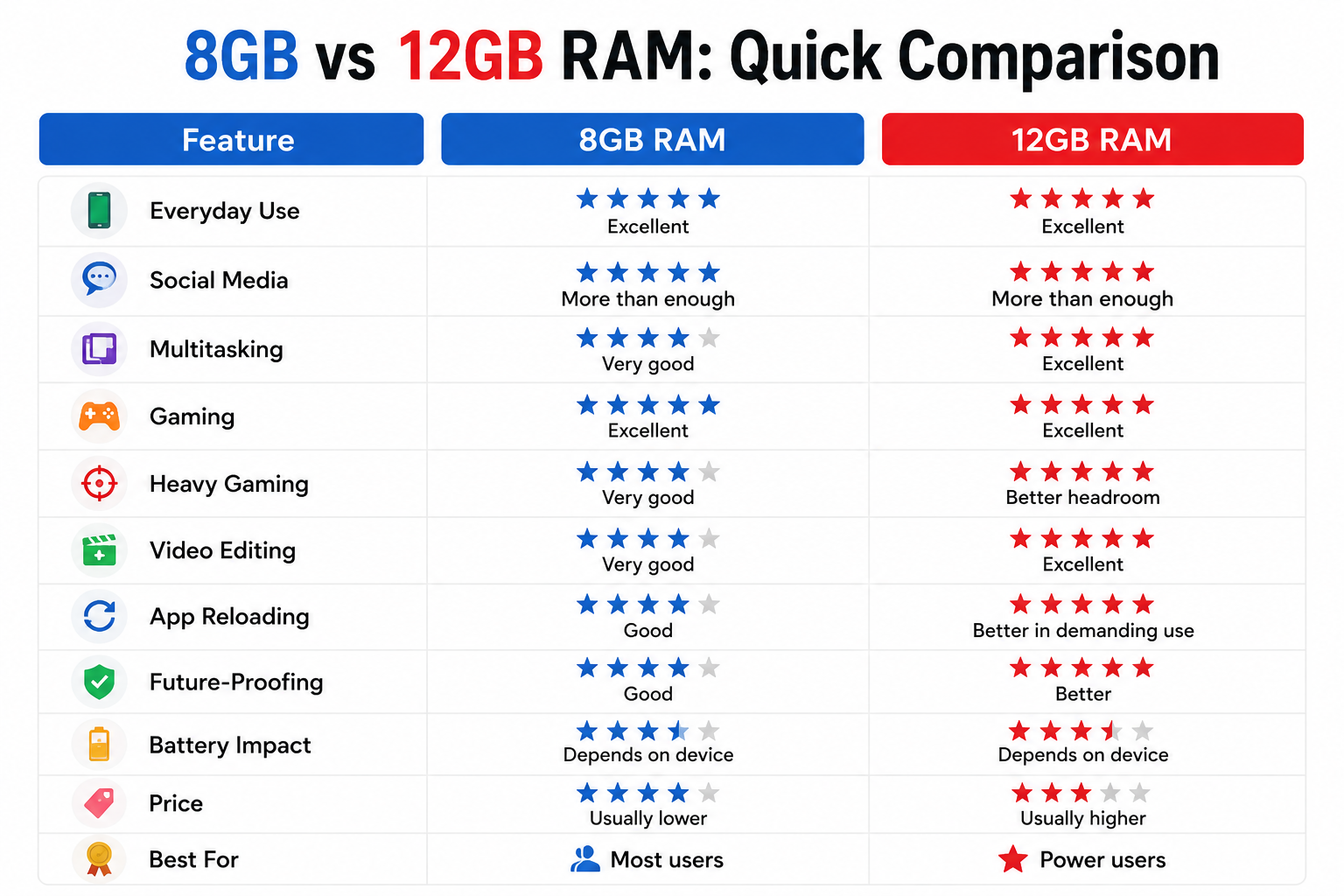
The important thing to understand is that 12GB RAM does not automatically make a phone 50% faster than an 8GB phone.
RAM mainly provides space for apps and processes to stay available in memory. The processor, storage, software optimization and cooling system also have a major influence on how fast the phone feels.
What Is RAM in a Smartphone?
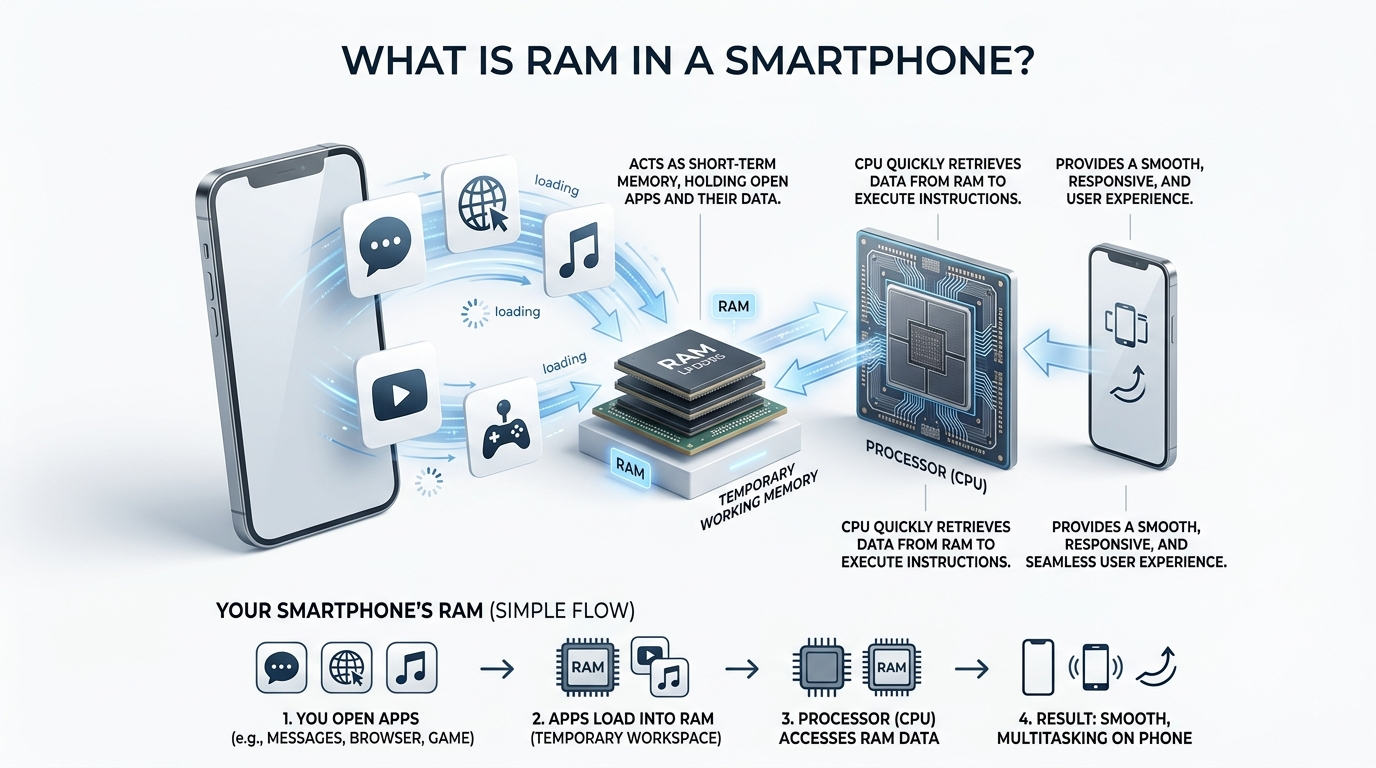
RAM stands for Random Access Memory.
Think of RAM as your smartphone's temporary workspace.
When you open an app, the phone needs memory to keep the app and its active data available. When you switch to another application, Android may keep the first app in memory so you can return to it quickly.
This is different from your phone's storage.
For example:
• 8GB RAM = temporary working memory
• 256GB storage = space for photos, videos, apps and files
A phone can have 8GB RAM and 256GB storage, or 12GB RAM and 128GB storage. These numbers describe completely different things.
Android's documentation explains that a device has RAM, zRAM and storage, with RAM being the fastest of these memory types. Android can also use zRAM as compressed swap space when memory pressure increases.
This is why simply looking at the amount of free RAM isn't a reliable way to judge a phone's performance.
How Android Uses RAM
One common misunderstanding is:
“My phone has only 2GB free RAM, so it's almost full and must be slow.”
That's not necessarily true.
Android is designed to make productive use of available memory. It can keep applications cached in RAM so that they can resume quickly when you return to them. Google describes Android's approach as essentially treating unused memory as an opportunity to keep useful processes available.
When memory becomes limited, Android can reclaim memory from cached processes and, when necessary, terminate background processes.
The low-memory killer prioritizes processes based on their importance, with background apps generally being among the first candidates for termination.
This means having 12GB doesn't mean all 12GB is sitting unused.
The system will use memory according to the workload.
8GB RAM: Is It Enough in 2026?
For most smartphone users, 8GB RAM is still enough.
If your daily activities include:
• WhatsApp
• Instagram
• Facebook
• YouTube
• Chrome
• Spotify
• Gmail
• Online shopping
• Light gaming
• Photography
an 8GB phone can provide a very smooth experience when paired with a good processor and optimized software.
You don't need 12GB just to send messages, watch videos or browse social media.
In fact, if two phones have the same processor, display and storage, the 8GB model may feel almost identical to the 12GB model during ordinary tasks.
The difference tends to become more noticeable when your workload becomes heavier.
12GB RAM: What Does the Extra Memory Actually Do?
The biggest advantage of 12GB RAM is additional headroom.
Imagine you open:
• Chrome
• YouTube
• Instagram
• WhatsApp
• Spotify
• A photo editor
• A large game
With more memory available, the system has more room to keep processes cached rather than reclaiming them immediately.
That can help reduce situations where you return to an older application and it has to reload from scratch.
However, this doesn't mean every app will remain open indefinitely.
Android can still remove background processes when memory pressure becomes high.
So 12GB is best understood as extra breathing room, not a magic performance upgrade.
8GB vs 12GB RAM for Multitasking
Multitasking is probably where the difference between the two configurations becomes easier to understand.
If you frequently switch between several demanding applications, more RAM can help the phone maintain more active processes.
For example, imagine you're working on a document, checking information in Chrome, responding to WhatsApp messages and editing a photo.
With 8GB RAM, this can still work very well.
With 12GB RAM, the device has additional memory available for these workloads.
But the exact experience depends on Android's memory management and the manufacturer's software.
Some phones aggressively close background applications to save battery. Others allow more applications to remain cached.
Therefore, 12GB doesn't guarantee perfect multitasking, but it gives the system more memory to work with.
Winner: 12GB RAM
8GB vs 12GB RAM for Gaming
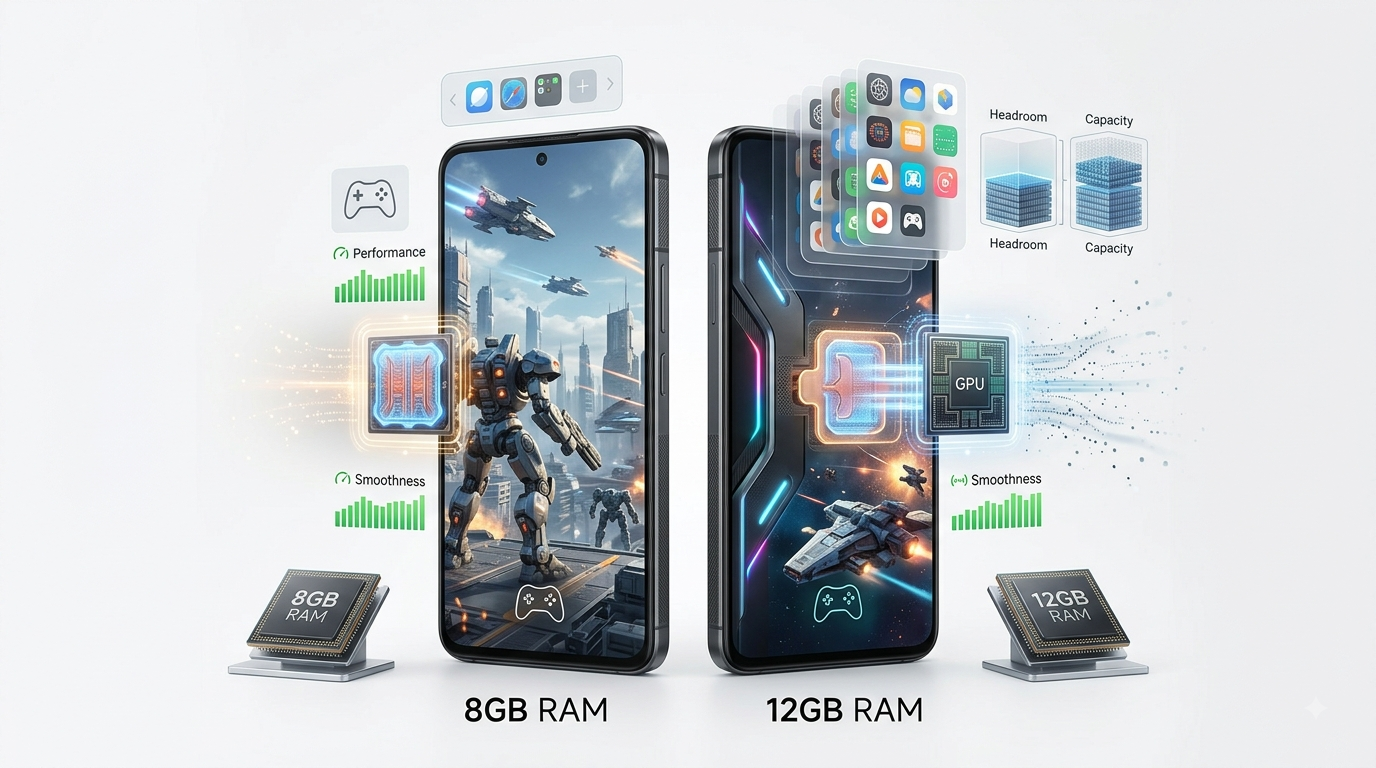
Gaming is another area where buyers often assume that more RAM automatically means higher FPS.
That's not quite how it works.
Your gaming performance depends heavily on:
• CPU
• GPU
• Game optimization
• Cooling
• Display refresh rate
• Storage speed
• RAM
• Software
RAM helps provide enough memory for the game and other system processes, but it isn't the only factor controlling frame rate.
For example, an 8GB phone with a powerful flagship processor can outperform a 12GB phone using a much weaker chipset.
That's why you should never buy a gaming phone based on RAM alone.
When 12GB helps
12GB can be useful if you:
• Play large games
• Stream games
• Record gameplay
• Switch between games and other apps
• Use gaming overlays
• Keep multiple apps running in the background
Android's game-development documentation notes that memory pressure can affect games and that the system may reclaim memory or terminate processes when resources become constrained.
Winner: 12GB for heavy gaming, but processor matters more
Does More RAM Increase FPS?
This is one of the biggest smartphone myths.
More RAM does not automatically increase FPS.
If your phone already has enough RAM for the game, adding more memory won't necessarily make the GPU render more frames per second.
For example, going from 8GB to 12GB won't magically turn a game running at 60 FPS into 120 FPS.
The GPU, processor, game settings and thermal performance have a much larger role in sustained frame rates.
More RAM can help when the device is under memory pressure, but it shouldn't be confused with raw graphics performance.
If gaming is your priority, I'd rather choose:
8GB RAM + powerful processor + good cooling
than:
12GB RAM + weak processor + poor cooling.
8GB vs 12GB RAM for Video Editing
Video editing is more demanding than ordinary social media usage.
Editing applications may need significant memory when working with:
• High-resolution videos
• Multiple video tracks
• EffectsTransitions
• Large photos
• 4K footage
• Background rendering
For casual editing, 8GB can be sufficient.
But if you regularly edit videos on your smartphone, 12GB gives the system additional memory headroom.
It can be particularly useful when you're switching between an editing application and other apps or working with larger projects.
Winner: 12GB
For serious mobile content creators, I'd choose 12GB if the price difference is reasonable.
8GB vs 12GB RAM for AI Features
Smartphone AI is becoming more important.
Modern phones can use AI for:
• Photo editing
• Generative image tools
• Voice processing
• Translation
• Summarization
• Object recognition
• Smart assistants
But RAM isn't the only component responsible for AI performance.
The processor's NPU, CPU and GPU are also important.
A phone with 12GB RAM doesn't automatically have better AI performance than an 8GB phone.
The AI capabilities depend on the complete hardware and software platform.
So if you're buying a phone primarily for AI, look at the processor and the actual AI features supported by the manufacturer instead of focusing only on RAM.
Winner: Depends on the phone
8GB vs 12GB RAM for Everyday Use
This is where 8GB RAM makes the most sense for many people.
If your phone is mainly used for:
• Calls
• WhatsApp
• Instagram
• YouTube
• Chrome
• Music
• Maps
• Banking
• Photography
then 8GB is generally plenty.
You may not notice a meaningful difference between 8GB and 12GB during ordinary daily use.
Instead of spending extra money on RAM you may never fully benefit from, you could consider putting that money toward:
• Better processor
• Better camera
• Larger battery
• Better display
• More storage
• Longer software support
Winner: 8GB for most users
Does 12GB RAM Make a Phone Faster?
Not necessarily.
This is an important distinction.
RAM capacity and processing speed are different things.
The processor determines how quickly the phone can execute many operations.
RAM provides space for active processes.
Think of it like a kitchen.
The processor is the chef.
RAM is the counter space.
A larger counter gives the chef more room to work, but it doesn't automatically make the chef faster.
That's why a phone with 8GB RAM and a powerful processor can feel faster than a phone with 12GB RAM and a weaker processor.
RAM vs Processor: Which Matters More?
If you're choosing between two smartphones, the processor is usually more important for overall performance than simply increasing RAM from 8GB to 12GB.
For example:
Phone A
• 8GB RAM
• Flagship processor
• Fast storage
• Good cooling
Phone B
• 12GB RAM
• Mid-range processor
• Slower storage
• Basic cooling
For demanding workloads, Phone A could easily be the better performer.
This is why your smartphone buying decision should consider the entire hardware package.
If you're comparing processors, you can also read our Snapdragon vs MediaTek comparison to understand how the chipset itself affects performance.
Does RAM Affect Battery Life?
This question is slightly more complicated.
More RAM itself doesn't automatically mean dramatically worse battery life.
Modern smartphones manage memory dynamically.
Android can reclaim memory when necessary and use compressed memory mechanisms such as zRAM under memory pressure.
However, keeping more processes active can potentially influence power consumption depending on what those processes are doing.
The biggest battery-life factors are generally the complete hardware and software design:
• Processor efficiency
• Display
• Refresh rate
• Battery capacity
• Network connection
• App behavior
• Software optimization
Therefore, don't buy an 8GB phone purely because you think it will automatically have better battery life.
Winner: No clear winner
8GB vs 12GB RAM for Long-Term Use
This is probably the strongest argument for choosing 12GB.
If you're planning to keep your smartphone for several years, apps and operating systems can become more demanding over time.
More RAM gives you additional headroom for future workloads.
That doesn't mean an 8GB phone will become unusable.
A well-optimized 8GB smartphone can remain perfectly capable for years.
But if the price difference is small, choosing 12GB can be a reasonable way to add some extra flexibility.
Winner: 12GB for long-term headroom
Is 16GB RAM Better Than 12GB?
If you're wondering whether you should skip 12GB and immediately buy 16GB, the answer depends heavily on your use.
For most smartphone users, 16GB is unnecessary.
If you're a regular user, 8GB is already sufficient.
If you're a heavy user, gamer or creator, 12GB is a comfortable choice.
16GB becomes more interesting for extremely demanding workloads and specialized flagship or gaming phones.
But again, don't pay a large premium simply for the bigger number.
A 16GB phone isn't automatically better if its processor, storage or software experience is inferior.
Virtual RAM: Is It the Same as Real RAM?
Many smartphone manufacturers advertise features such as:
• Virtual RAM
• RAM Expansion
• RAM Boost
• Extended RAM
These features generally use a portion of storage to help handle memory pressure.
But virtual RAM is not the same as physical RAM.
Physical RAM is much faster and is designed specifically for active memory workloads.
Storage-based memory expansion can be useful in certain situations, but it shouldn't be treated as equivalent to buying a phone with more physical RAM.
So:
8GB physical RAM + virtual RAM ≠ 12GB physical RAM.
When comparing smartphones, always check the actual physical RAM configuration.
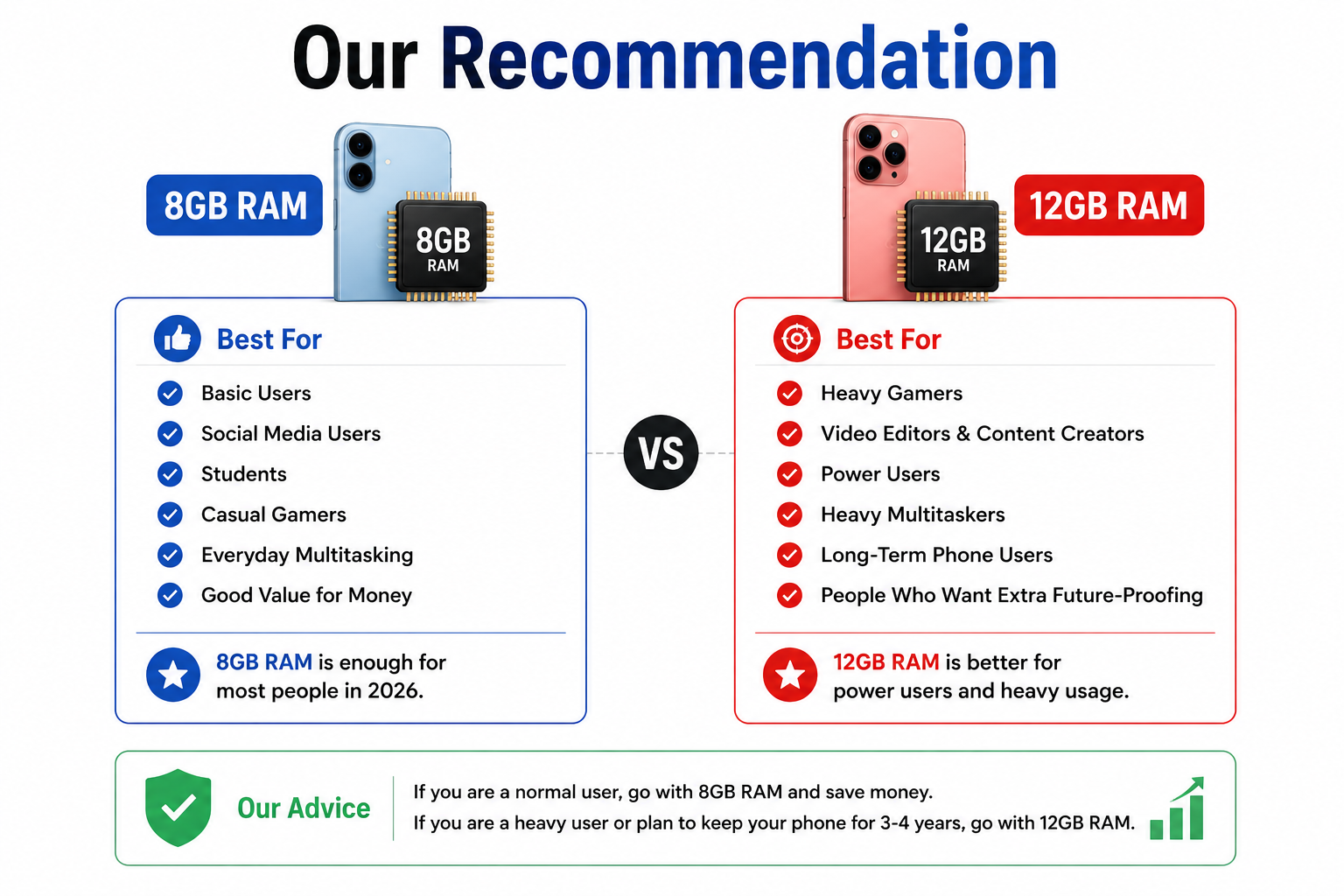
8GB vs 12GB RAM: Who Should Buy Which?
Let's make the decision simple.
Choose 8GB RAM if you:
• Mostly use social media
• Watch YouTube and Netflix
• Browse the internet
• Use messaging apps
• Take photos
• Play casual games
• Want better value
• Don't keep dozens of apps active
For these users, 8GB is usually the smarter choice.
Choose 12GB RAM if you:
• Play demanding games
• Edit videos regularly
• Multitask heavily
• Use many apps simultaneously
• Want additional future headroom
• Keep your phone for several years
• Use demanding productivity applications
For these users, 12GB makes more sense.
8GB vs 12GB RAM: What About 2026 Smartphones?
In 2026, the smartphone market has moved toward increasingly powerful processors, more sophisticated AI features and heavier applications.
Google's Android development documentation also highlights the growing importance of memory efficiency, including changes around app memory limits in Android 17.
This doesn't mean every phone suddenly needs 12GB or more.
Instead, it means manufacturers and software developers are paying more attention to how memory is allocated and managed.
For buyers, this reinforces an important point:
RAM capacity is only one part of smartphone performance.
A balanced device is usually better than one with an impressive RAM number but weaker components elsewhere.
Common Myths About Smartphone RAM
Myth 1: More RAM Always Means a Faster Phone
False.
More RAM can improve multitasking headroom, but processor performance has a major effect on speed.
Myth 2: Free RAM Means Better Performance
False.
Android intentionally uses available memory to keep apps cached and improve responsiveness.
Myth 3: 12GB RAM Automatically Gives Higher FPS
False.
FPS is heavily influenced by the CPU, GPU, game optimization and cooling.
Myth 4: Virtual RAM Is the Same as Physical RAM
False.
Storage-based memory expansion cannot simply replace physical RAM.
Myth 5: 8GB RAM Will Become Useless Soon
Not necessarily.
An 8GB phone with a strong processor and good software optimization can remain capable for years.
8GB vs 12GB RAM: Final Verdict
So, does more RAM really matter in 2026?
Yes—but probably not as much as smartphone advertisements sometimes make it seem.
For the average user, 8GB RAM is still a very sensible choice.
It provides enough memory for everyday apps, social media, browsing, streaming and normal multitasking.
If you're a heavy gamer, video editor, power user or someone who wants extra headroom for future applications, 12GB RAM is the better choice.
The important thing is not to look at RAM in isolation.
When buying a smartphone, consider:
1. Processor
2. RAM
3. Storage technology
4. Display
5. Battery
6. Cooling
7. Software optimization
8. Update policy
9. Camera hardware
10. Price
If you have a limited budget, I'd usually prefer 8GB RAM with a stronger processor over 12GB RAM with a weaker processor.
If the price difference between identical 8GB and 12GB models is relatively small, however, choosing 12GB can be a sensible long-term investment.