Meta description
AMOLED vs OLED vs LCD explained: Compare picture quality, brightness, battery life, gaming, burn-in, viewing angles and price to find the best display in 2026.
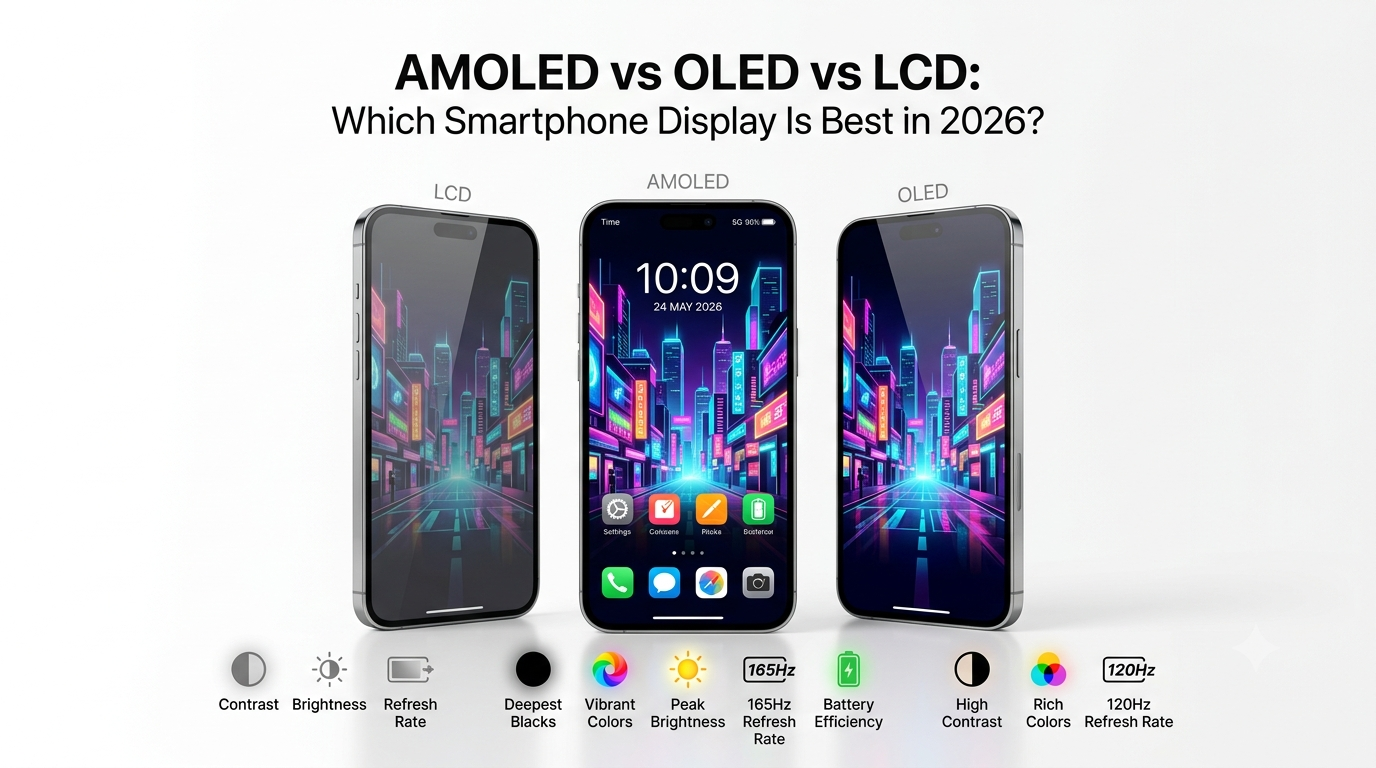
AMOLED vs OLED vs LCD: Which Smartphone Display Is Best in 2026?
When buying a new smartphone, most people look at the processor, camera, battery and RAM before making a decision. But there is one component that you interact with every single time you use your phone: the display.
Whether you're watching YouTube, scrolling through Instagram, playing games, reading an article or simply checking a WhatsApp message, the screen determines how that content looks.
In 2026, smartphone displays have become significantly better than they were a few years ago. Even many affordable phones now offer high refresh rates, better brightness and improved color reproduction. At the same time, premium smartphones increasingly use advanced OLED-based panels.
This creates an important question:
Should you buy a phone with AMOLED, OLED or LCD?
At first glance, these technologies may sound very similar. AMOLED and OLED are closely related technologies, while LCD works in a completely different way.
OLED displays are self-emissive, meaning their pixels produce their own light. LCD panels, on the other hand, require a separate backlight. This fundamental difference affects contrast, thickness, black levels and other aspects of the viewing experience.
So, which display is actually best in 2026?
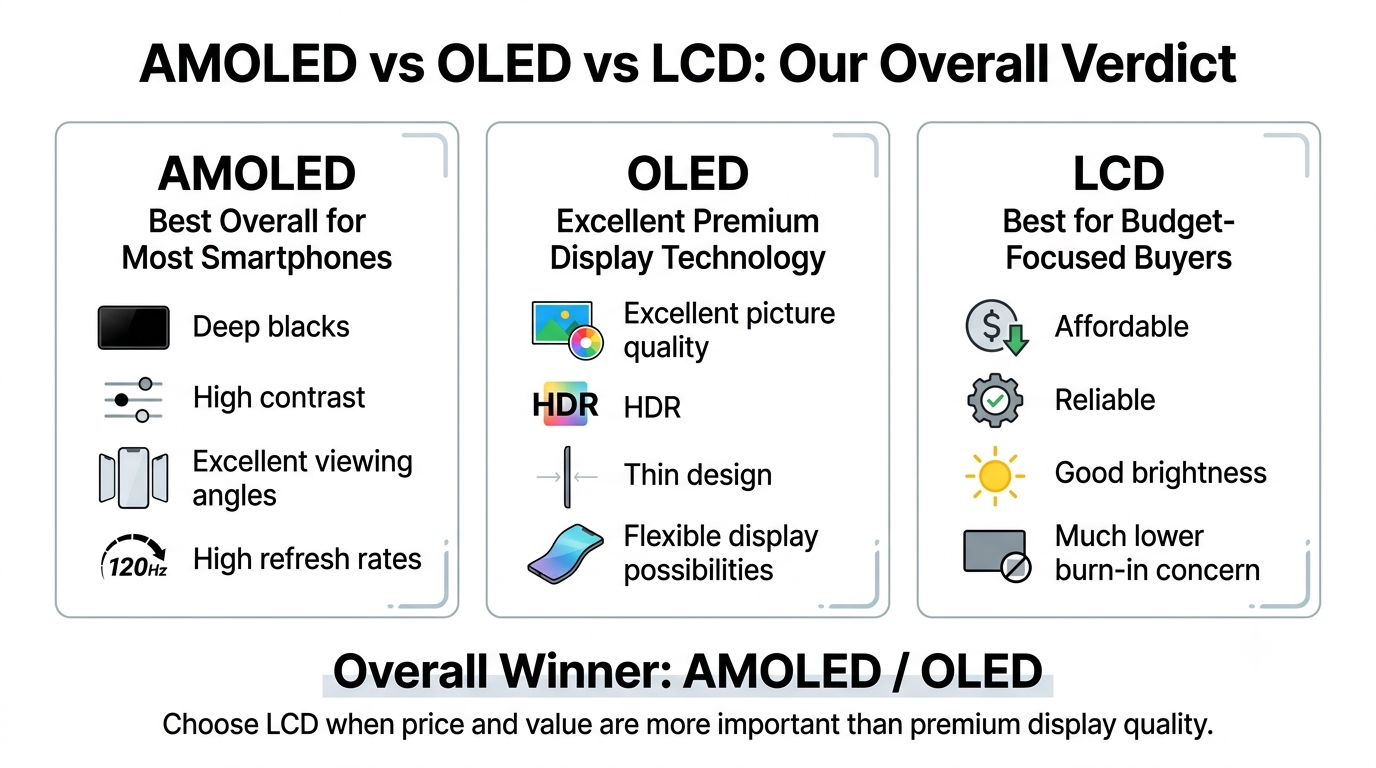
The answer depends on what you care about most. For most smartphone buyers, AMOLED/OLED is the better overall choice, but LCD can still make sense when price, durability and value are more important.
Let's break everything down.
What Is an LCD Display?
LCD stands for Liquid Crystal Display.
It has been used in smartphones for many years and remains common in budget and some mid-range devices.
Unlike OLED, an LCD doesn't produce light at each individual pixel. Instead, it uses a backlight behind the display. The liquid-crystal layer controls how much light passes through to create the image.
This basic design has several advantages.
LCD technology can be relatively affordable to manufacture, which makes it useful for lower-cost smartphones.
A good LCD can also produce natural-looking colors and decent brightness. For everyday activities such as browsing websites, reading messages and watching videos, a high-quality LCD can still provide a perfectly enjoyable experience.
However, LCD has an important limitation.
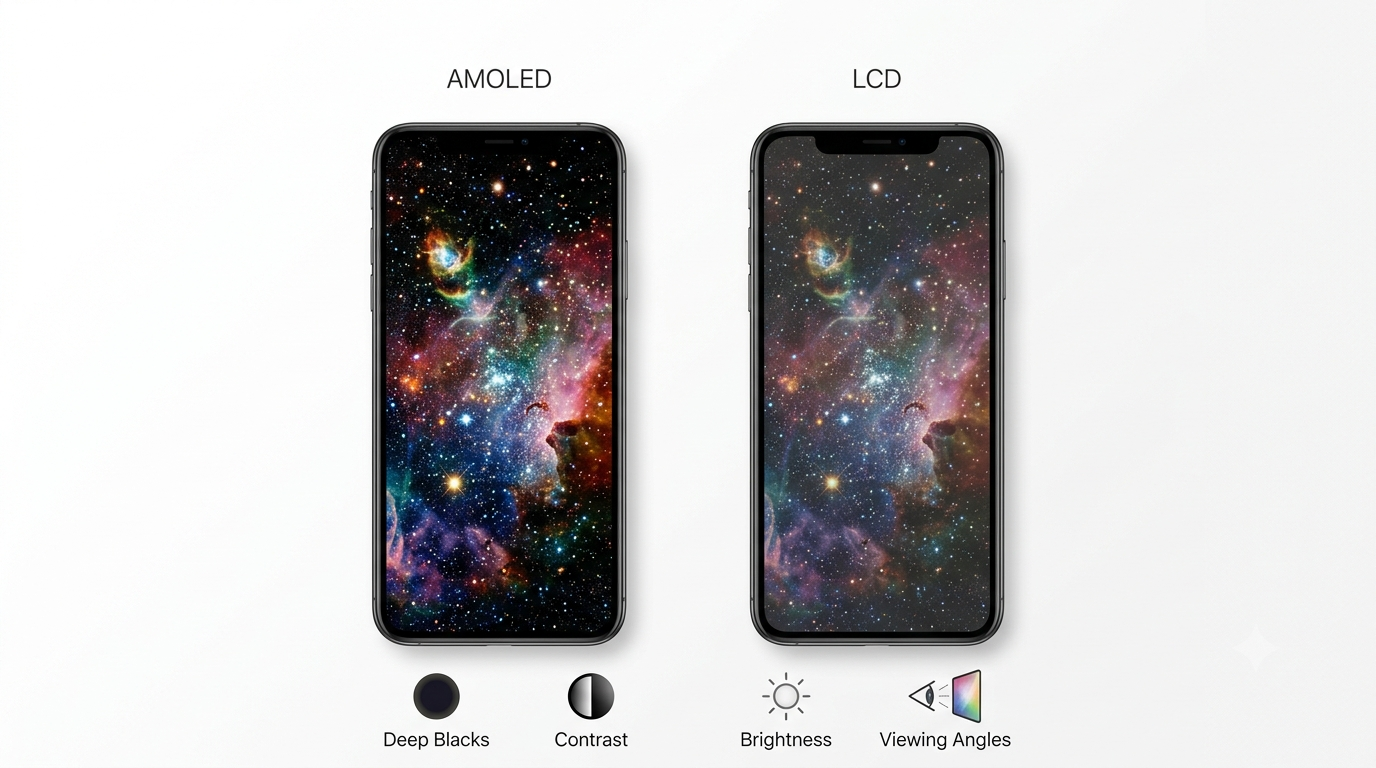
Because the backlight is generally active across the display, producing truly deep black is difficult. A black area on an LCD can appear more like dark gray because some backlight can still pass through.
OLED technology approaches this differently.
What Is OLED?
OLED stands for Organic Light-Emitting Diode.
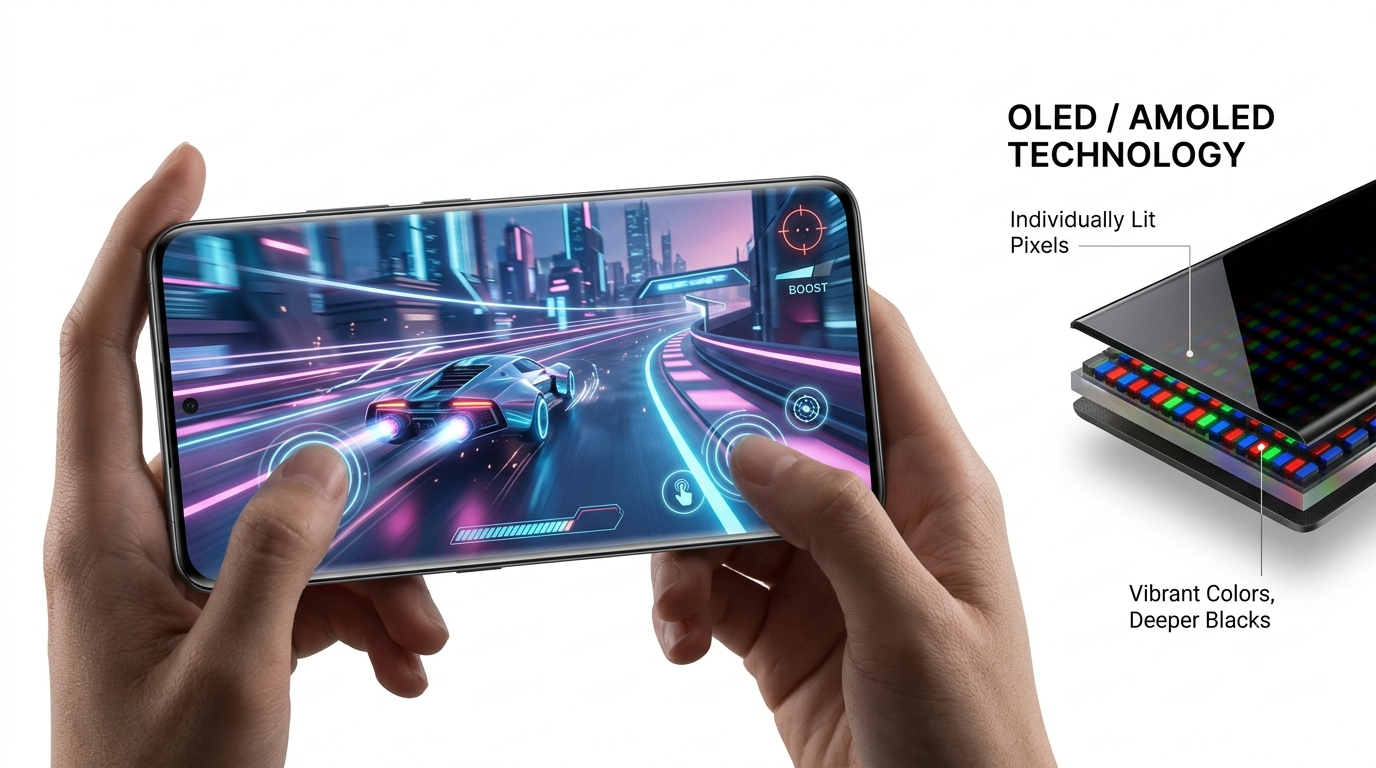
The major difference is that OLED pixels are self-emissive. Each pixel can produce its own light instead of relying on a separate backlight.
Samsung Display explains that OLED pixels use organic materials that emit light when electrical current is applied. Because OLED does not need a separate backlight unit, the technology can enable thinner and lighter displays as well as strong contrast and other image-quality advantages.
This gives OLED a major advantage when displaying black.
If a pixel needs to display black, it can essentially turn off.
That's why OLED screens can produce extremely deep blacks.
And this is where AMOLED comes into the discussion.
What Is AMOLED?
AMOLED stands for Active Matrix Organic Light-Emitting Diode.
In simple terms, AMOLED is a type of OLED display that uses an active-matrix system to control its pixels.
So when you compare OLED and AMOLED, it's important to understand that AMOLED isn't simply a completely separate technology from OLED.
AMOLED is an OLED display technology.
The term is particularly common in smartphone marketing.
Modern AMOLED smartphone panels can offer:
• Deep blacks
• High contrast
• Strong colors
• Fast response times
• Thin designs
• Excellent viewing angles
• High refresh rates
• Always-On Display support
However, not every AMOLED panel is identical.
One phone can have a much better AMOLED display than another despite both using the word “AMOLED” in their specifications.
Panel quality, brightness, calibration, refresh rate and manufacturer tuning all matter.
AMOLED vs OLED: What's the Difference?
This is where many smartphone buyers get confused.
If a phone says OLED and another says AMOLED, does that automatically mean AMOLED is better?
Not necessarily.
AMOLED is essentially a specific type of OLED technology.
The real-world quality depends on the actual panel.
For example, one AMOLED display could have:
• 120Hz refresh rate
• Excellent brightness
• Accurate colors
• Better calibration
while another OLED display could have:
• 60Hz refresh rate
• Lower brightness
• Less accurate calibration
In that situation, the AMOLED phone may obviously provide a better experience.
But the name alone doesn't guarantee superiority.
The important point
Don't choose a smartphone display based only on “AMOLED” or “OLED” written in the specifications.
Check the complete display specifications.
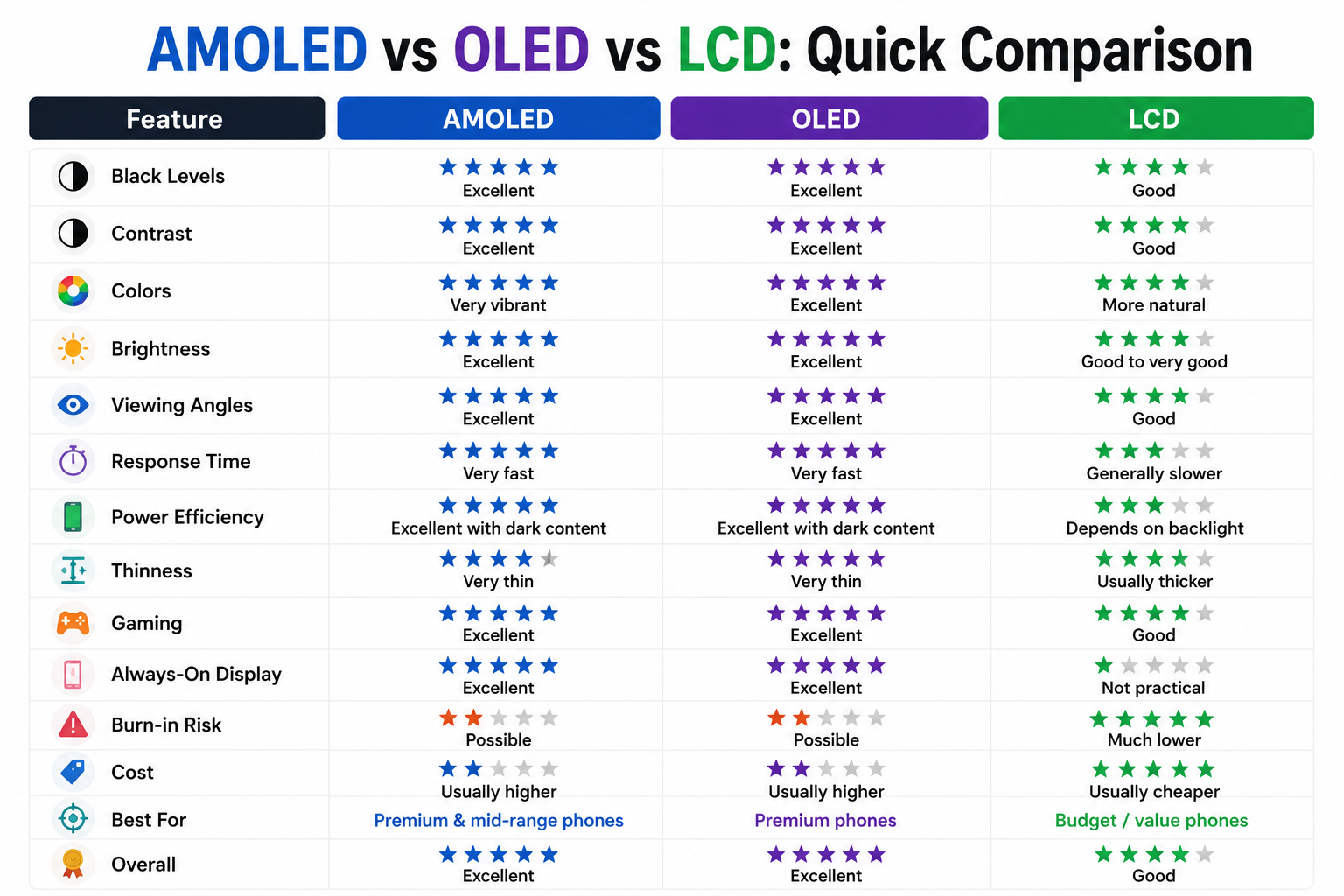
AMOLED vs LCD: Picture Quality
Picture quality is one of the biggest differences between AMOLED and LCD.
OLED-based displays can produce extremely deep blacks because individual pixels can be switched off.
That creates a very high perceived contrast ratio.
Imagine watching a movie at night.
With an OLED display, the dark parts of the scene can look genuinely black.
On an LCD, those same areas can appear somewhat gray because the backlight remains active.
This doesn't mean every LCD looks bad.
A high-quality LCD can still have good contrast, accurate colors and excellent sharpness.
But when comparing similarly priced modern panels, OLED generally has the advantage in black levels and contrast.
Winner: AMOLED/OLED
AMOLED vs LCD: Colors
Colors are another area where OLED smartphones often stand out.
AMOLED panels can produce highly vibrant colors and strong contrast.
This makes photos, videos and games look visually impressive.
However, “more colorful” doesn't necessarily mean “more accurate.”
Some displays are tuned for extremely saturated colors because manufacturers believe users prefer a more vibrant appearance.
Other phones offer more natural color profiles.
So if you care about accurate colors for photography or content creation, look beyond the AMOLED label and check display calibration and available color modes.
Winner: Depends on calibration
AMOLED vs LCD: Brightness
Brightness is extremely important if you frequently use your phone outdoors.
A display can look fantastic indoors but become difficult to read under direct sunlight if its outdoor brightness is limited.
Modern OLED smartphone panels can achieve very high brightness levels. Samsung Display, for example, has demonstrated smartphone OLED technology capable of very high peak luminance and has highlighted outdoor visibility as an important part of smartphone display performance.
But this doesn't mean every OLED automatically beats every LCD.
Some LCD panels can also become quite bright.
When comparing phones, look for the manufacturer's rated peak or high-brightness figure, but remember that peak brightness isn't necessarily the same as sustained brightness across the entire screen.
Winner: OLED/AMOLED on many modern phones, but check the actual specifications
AMOLED vs LCD: Battery Life
Battery efficiency is more complicated than simply saying “AMOLED saves battery.”
Because OLED pixels generate their own light, displaying dark content can reduce power consumption compared with displaying bright content.
Dark mode can therefore be particularly useful on OLED displays.
Samsung Display has developed several OLED technologies specifically aimed at improving smartphone power efficiency, including adaptive refresh-rate technologies that dynamically adjust the display refresh rate according to the content being shown.
However, battery consumption depends on much more than panel type.
It can be affected by:
• Brightness
• Refresh rate
• Resolution
• Processor efficiency
• Screen size
• App usage
• Network connection
• Software optimization
A 120Hz AMOLED display running at very high brightness can still consume significant power.
Winner: AMOLED/OLED, especially with dark content and adaptive refresh rate
AMOLED vs LCD for Gaming
If you enjoy mobile gaming, your display matters almost as much as the processor.
A gaming display should ideally provide:
• High refresh rate
• Fast response time
• Good touch response
• Low motion blur
• Strong brightness
• Good color reproduction
OLED-based displays generally have very fast pixel response characteristics, which can make moving objects look cleaner.
Modern AMOLED panels can also support high refresh rates such as 90Hz, 120Hz and beyond.
However, refresh rate should not be confused with FPS.
A 120Hz display doesn't automatically mean every game will run at 120 FPS.
The phone's processor and GPU must be capable of rendering enough frames.
If your phone can run a game at high frame rates, a high-refresh-rate OLED display can make the experience feel smoother.
Winner: AMOLED/OLED
AMOLED vs LCD: Viewing Angles
Viewing angles describe how well the display remains visible when you're looking at it from the side.
OLED technology generally performs very well here.
Colors and contrast can remain consistent across wider viewing angles.
LCD panels can also have good viewing angles, particularly higher-quality IPS LCD panels, but performance varies significantly between different LCD implementations.
For a smartphone that you frequently share with someone else or view from different angles, OLED has a strong advantage.
Winner: AMOLED/OLED
AMOLED vs LCD: Always-On Display
Always-On Display is another feature associated with OLED smartphones.
Because OLED pixels can be individually controlled, the phone can illuminate only a small portion of the screen to show information such as:
• Time
• Date
• Notifications
• Battery status
• Music controls
The rest of the screen can remain dark.
LCD isn't as well suited to this type of implementation because the backlight generally has to operate across the panel.
This is one reason Always-On Display features are particularly common on OLED-based smartphones.
Winner: AMOLED/OLED
AMOLED vs LCD: Thickness and Design
OLED displays don't require the same type of backlight structure used by LCD.
This allows manufacturers to create thinner display modules and explore flexible form factors.
Samsung Display notes that OLED's simpler structure can contribute to thinner and lighter designs and has helped enable flexible displays.
This is particularly important for:
• Foldable phones
• Curved displays
• Thin flagship phones
• Edge-to-edge designs
LCD can still be used in slim smartphones, but OLED offers greater flexibility for certain modern form factors.
Winner: OLED/AMOLED
AMOLED vs LCD: Burn-In
This is one area where LCD has an advantage.
OLED displays can experience image retention or burn-in under certain conditions.
Burn-in happens when certain pixels age differently after displaying static elements for very long periods.
For example, a static interface element displayed continuously over an extended period could potentially contribute to uneven pixel aging.
Modern OLED smartphones use various techniques to reduce this risk, and normal use doesn't mean your screen will automatically develop burn-in.
Still, the underlying possibility exists because OLED pixels are self-emissive.
LCD doesn't have the same organic-pixel aging mechanism.
Winner: LCD
Which Display Is Better for Reading?
If you spend a lot of time reading articles, PDFs, books or documents, both technologies can work well.
OLED provides excellent contrast and deep blacks, which can make dark-themed reading particularly attractive.
LCD can also be comfortable for reading, particularly when it has good brightness and accurate color reproduction.
What matters more than OLED versus LCD is:
• Resolution
• Brightness
• Refresh rate
• Text sharpness
• Viewing distance
• Software
Your personal preference
For long reading sessions, you may also want to consider a phone's eye-comfort or blue-light reduction modes.
Winner: Personal preference
AMOLED vs LCD: Outdoor Visibility
Outdoor visibility depends heavily on brightness and reflections.
A display with excellent peak brightness can remain much easier to see in sunlight.
Modern OLED technology has made major progress in outdoor visibility. Samsung Display has demonstrated smartphone OLED panels designed specifically to improve sunlight visibility through higher luminance and improved display characteristics.
But again, don't assume that every AMOLED phone has better outdoor visibility than every LCD phone.
Check the actual smartphone's brightness rating and independent reviews when available.
Winner: Depends on the specific panel
Which Display Is Better for HDR?
HDR stands for High Dynamic Range.
HDR content attempts to provide a wider range between very dark and very bright parts of an image while preserving more detail and richer colors.
OLED is particularly well suited to HDR because it can produce extremely dark blacks while also delivering bright highlights.
This can create a strong sense of contrast.
However, good HDR performance depends on the complete display system, including:
• Peak brightness
• Sustained brightness
• Color gamut
• HDR certification
• Panel quality
• Software support
Therefore, don't assume that simply having an AMOLED panel guarantees excellent HDR.
Winner: AMOLED/OLED
AMOLED vs OLED vs LCD: Which Is More Durable?
Durability is not simply a matter of display technology.
Modern smartphone screens are protected by strengthened cover glass and other protective layers.
The panel itself is only one part of the equation.
OLED displays can have concerns such as burn-in, while LCD doesn't have the same pixel-aging issue.
But physical damage from:
• Drops
• Scratches
• Pressure
• Water
• Bending
depends heavily on the phone's construction.
A good OLED smartphone with strong protective glass can be more durable in practical use than a poorly built LCD phone.
Winner: Depends on the smartphone
Is AMOLED Worth Paying More For?
For many buyers, yes.
If you're moving from a basic LCD phone to a good AMOLED smartphone, the difference can be immediately noticeable.
You'll likely notice:
• Deeper blacks
• Stronger contrast
• More vibrant visuals
• Better viewing angles
• Smoother high-refresh-rate options
• Better movie and gaming experience
But there's an important question:
How much extra are you paying?
If an AMOLED phone costs ₹5,000–₹10,000 more but has a much weaker processor, worse camera and smaller battery, the display alone may not justify the extra money.
A smartphone should be judged as a complete package.
AMOLED vs OLED vs LCD for Budget Phones
LCD remains relevant in the budget smartphone market because it can help manufacturers keep prices under control.
If you're buying a phone around the lower price ranges, a good LCD can still be perfectly acceptable.
But the availability of affordable AMOLED phones has changed the market.
Today, buyers don't necessarily need to purchase a flagship smartphone to get an OLED-based display.
This is one of the biggest improvements in smartphone displays over recent years.
Our advice
If two phones have similar:
• Processor
• Camera
• Battery
• Software support
• Storage
and one offers AMOLED while the other offers LCD for a reasonable price difference, we would generally choose AMOLED.
AMOLED vs OLED vs LCD for Premium Phones
At the premium end of the market, OLED-based technology is generally the preferred choice.
Flagship smartphones benefit from:
• Excellent contrast
• High brightness
• High refresh rates
• Thin construction
• Flexible designs
• HDR support
• Better viewing angles
Foldable smartphones especially benefit from flexible OLED technology.
Samsung Display's ongoing 2026 research and development also shows how OLED technology continues to evolve, with new approaches targeting higher brightness, wider color gamut and new display capabilities.
So for premium smartphones, OLED-based displays are likely to remain dominant.
AMOLED vs OLED vs LCD: Common Mistakes Buyers Make
Mistake 1: Looking Only at the Display Type
“AMOLED” sounds impressive, but it doesn't tell you everything.
Two AMOLED displays can have very different brightness, refresh rates and color accuracy.
Mistake 2: Assuming 120Hz Is Always Better
A higher refresh rate can make scrolling and animation smoother, but it can also affect power consumption.
Adaptive refresh-rate technology can help balance smoothness and efficiency.
Mistake 3: Ignoring Brightness
A beautiful display is less useful outdoors if it isn't bright enough.
Mistake 4: Ignoring Resolution
Display technology and resolution are separate specifications.
An AMOLED display isn't automatically sharper than an LCD.
Mistake 5: Paying Too Much for the Screen
Don't spend your entire smartphone budget on display quality while ignoring the processor, camera and battery.
AMOLED vs OLED vs LCD: What Should You Check Before Buying?
Instead of simply asking “AMOLED or LCD?”, check these specifications:
1. Display Type
AMOLED, OLED or LCD.
2. Refresh Rate
60Hz, 90Hz, 120Hz or higher.
3. Peak Brightness
Important for outdoor use.
4. Resolution
Higher resolution generally produces sharper images and text.
5. HDR Support
Useful for compatible movies and videos.
6. Touch Sampling Rate
Especially important for gamers.
7. Color Accuracy
Important for photographers and content creators.
8. Adaptive Refresh Rate
Can help balance smoothness and battery consumption.
9. Protection
Check the type of cover glass and overall build.
10. Independent Reviews
Real-world testing can reveal things that specifications don't.
Which Display Should You Buy in 2026?
Let's make the decision simple.
📱 For Most Smartphone Users
AMOLED/OLED
You'll get excellent contrast, vibrant images, deep blacks and a premium viewing experience.
🎮 For Gamers
AMOLED/OLED with 120Hz or higher
Look for a high refresh rate, fast touch response and good brightness.
🎬 For Movies and Netflix
AMOLED/OLED
The deep blacks and high contrast can make movies look more immersive.
📚 For Reading
Either
Choose based on brightness, resolution and your personal comfort.
💰 For Budget Buyers
LCD can still be a good choice
If the phone has a strong processor and good overall hardware, don't reject it simply because it uses LCD.
🏆 For Flagship Buyers
AMOLED/OLED
For premium smartphones, OLED-based technology is generally the better choice.
AMOLED vs OLED vs LCD: Final Verdict
So, which smartphone display is best in 2026?
For most people, the answer is AMOLED/OLED.
The technology provides several advantages over traditional LCD, including self-emissive pixels, excellent black levels, high contrast, thin designs and strong viewing angles. OLED also allows manufacturers to build flexible displays, which is particularly useful for modern foldable smartphones.
AMOLED is not automatically better than every OLED panel, because AMOLED is itself a type of OLED technology. The quality of the actual panel matters much more than the marketing name.
LCD, meanwhile, is far from useless.
A good LCD can still provide a sharp, bright and enjoyable smartphone experience. It can also be a smart choice when you're trying to keep the price of a phone low.
The biggest thing to remember is that display type is only one part of a smartphone.
Before buying a phone, also consider:
• Processor
• RAM
• Storage
• Battery
• Camera
• Refresh rate
• Brightness
• Software updates
• Build quality
• Price