
Meta Description:
UFS 3.1 vs UFS 4.0 explained. Compare speed, gaming, file transfers, battery efficiency and real-world performance to choose the right smartphone storage.
UFS 3.1 vs UFS 4.0: What’s the Difference and Does It Matter in 2026?
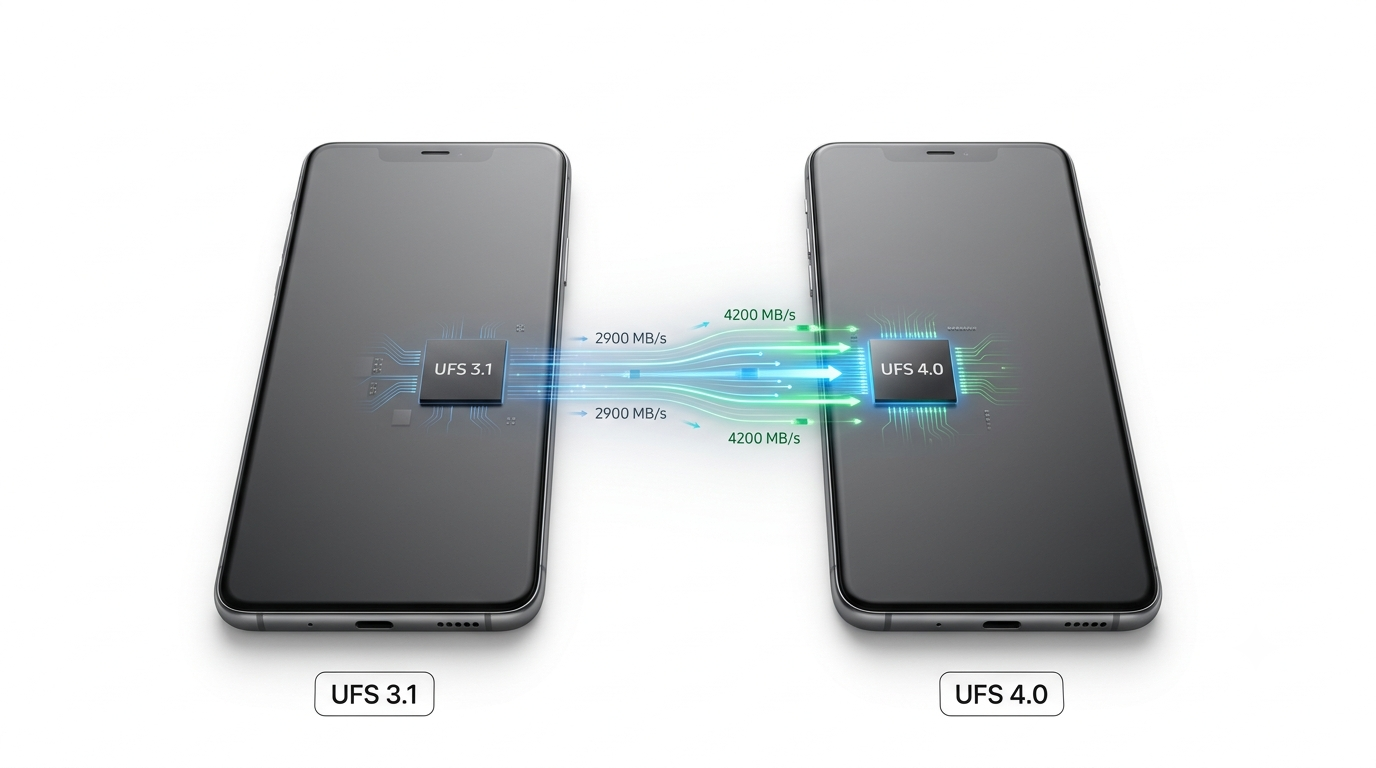
When buying a new smartphone, most people check the processor, RAM, camera, battery and display. Storage capacity is another important factor, especially when choosing between 128GB, 256GB and 512GB.
But there is one storage specification that many buyers ignore: UFS.
You may have seen UFS 3.1 and UFS 4.0 mentioned in smartphone specifications. But what do these terms actually mean? Is UFS 4.0 really faster? Does it improve gaming and app loading? And is it worth paying extra for a phone with UFS 4.0 in 2026?
Let's find out.
*Actual speeds vary depending on the storage chip, capacity, controller, smartphone and workload. Samsung's published figures for its UFS implementations illustrate the performance difference between the generations.
What Is UFS in a Smartphone?
UFS stands for Universal Flash Storage. It is the technology used for a smartphone's internal storage.
Your phone's internal storage holds your apps, photos, videos, games, documents and system files.
UFS is different from RAM. RAM temporarily stores information that the processor needs while you're using the phone, while UFS storage keeps your data even after the phone is switched off.
The UFS version can affect how quickly data is read from or written to the phone's internal storage.
In simple terms, newer UFS technology generally provides higher performance and better efficiency.
UFS 3.1 vs UFS 4.0: Quick Comparison
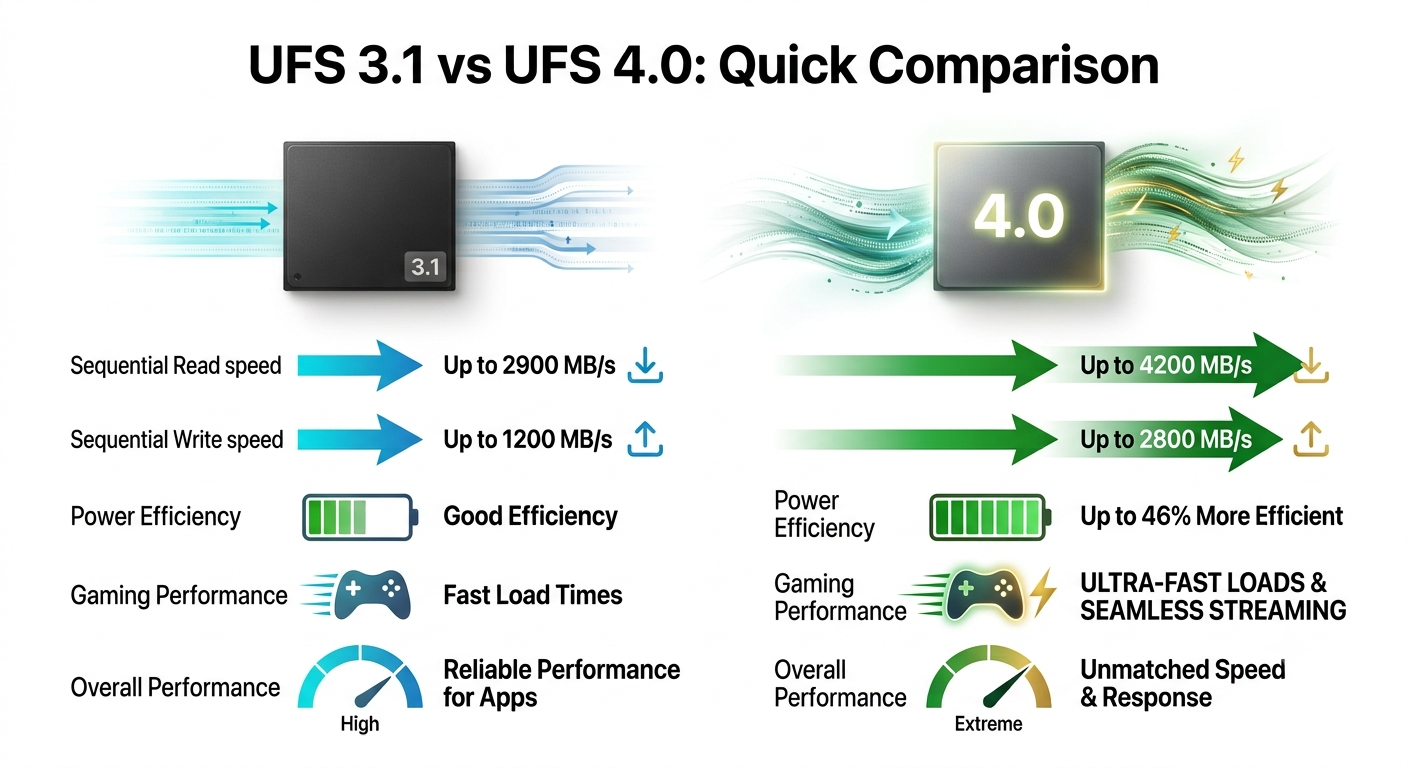
*Actual speeds vary depending on the storage chip, capacity, controller, smartphone and workload. Samsung's published figures for its UFS implementations illustrate the performance difference between the generations.
What Is UFS 3.1?
UFS 3.1 is a high-speed smartphone storage standard that became widely used in smartphones before UFS 4.0 arrived.
It was designed to handle demanding tasks such as large applications, high-resolution photos, video recording and 5G-era smartphones.
Samsung's UFS 3.1 products support capacities up to 1TB, with write performance varying according to capacity. Samsung also introduced features such as Write Booster to improve storage write performance.
Even though UFS 4.0 is newer, UFS 3.1 is still fast enough for many smartphone users.
If you use your phone mainly for WhatsApp, Instagram, YouTube, browsing, photography and casual gaming, you probably won't find UFS 3.1 slow.
What Is UFS 4.0?
UFS 4.0 is the newer generation of smartphone storage.
Samsung introduced its UFS 4.0 solution in 2022 and reported sequential read speeds of up to 4,200MB/s and sequential write speeds of up to 2,800MB/s. Samsung also reported up to 23.2Gbps per lane for the interface.
These numbers represent a major improvement over previous UFS technology.
But UFS 4.0 isn't only about speed.
It was also designed to improve power efficiency, which is particularly important for modern smartphones handling large amounts of data.
UFS 3.1 vs UFS 4.0: Speed Difference
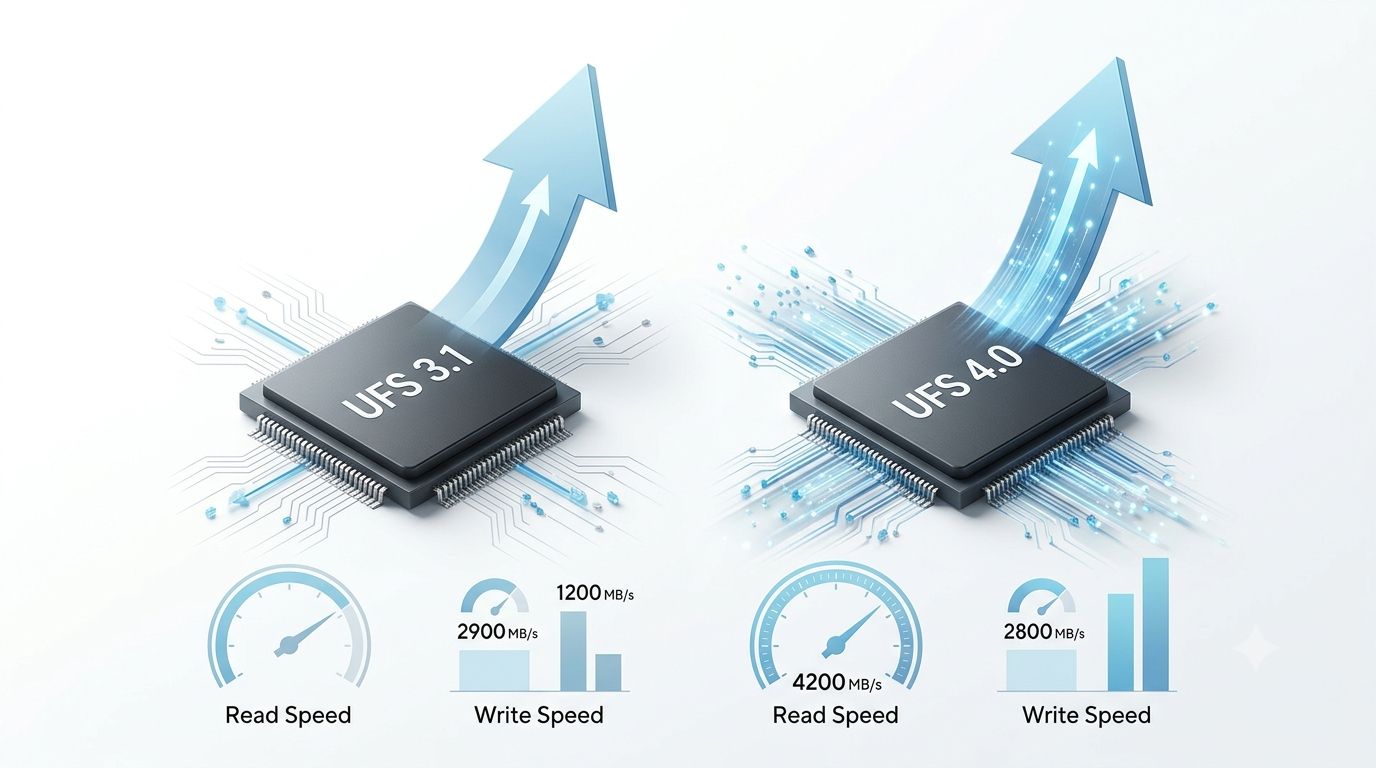
The biggest advantage of UFS 4.0 is its higher performance.
Samsung's UFS 4.0 implementation can reach up to 4,200MB/s sequential read and 2,800MB/s sequential write. Samsung compared these figures with its previous UFS 3.1 solution and reported approximately twice the sequential read performance and around 1.6 times the sequential write performance.
However, don't assume that a UFS 4.0 smartphone will open every app twice as fast.
Smartphone performance depends on many other components, including:
• Processor
• RAM
• Software optimization
• App design
• Storage controller
• Thermal performance
So faster storage helps, but it isn't the only thing that determines how fast a phone feels.
Winner: UFS 4.0
Does UFS 4.0 Improve Gaming?
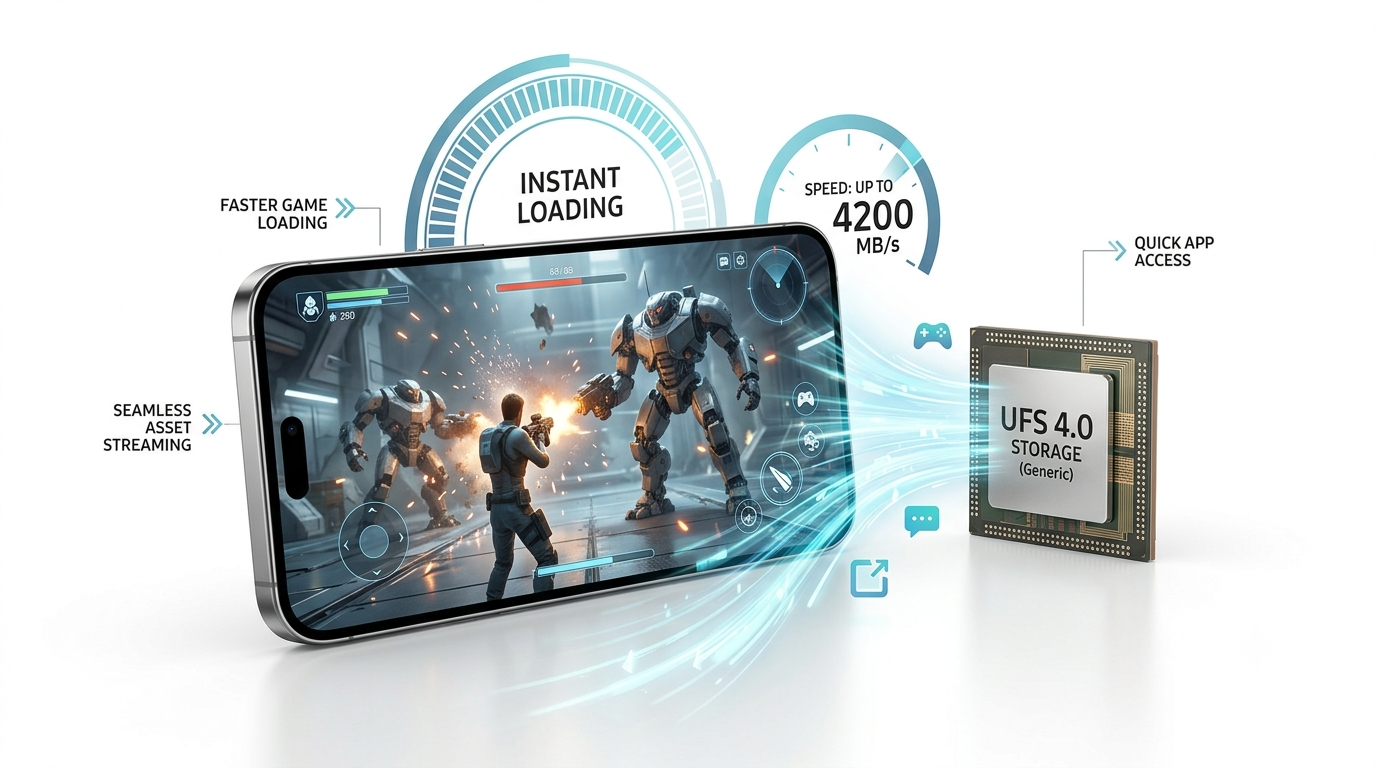
It can, but UFS 4.0 does not directly increase FPS.
Gaming FPS mainly depends on the processor, GPU, cooling system and game optimization.
Where UFS 4.0 can help is with storage-intensive tasks.
Modern games can contain huge amounts of:
• 3D assets
• Textures
• Audio
• Maps
• Cutscenes
• Game files
Faster storage can help the phone access these files more quickly.
This can potentially improve game loading and other storage-related tasks.
However, if you're choosing between a phone with a powerful processor and UFS 3.1 and another with a weaker processor and UFS 4.0, the stronger processor will generally be more important for gaming.
For gaming: Processor first, UFS second.
UFS 3.1 vs UFS 4.0 for File Transfers
Large file transfers are another situation where faster storage can be useful.
For example, if you're frequently:
• Recording high-resolution videos
• Editing large files
• Moving hundreds of photos
• Installing large games
• Creating backups
the storage system has to handle a lot of data.
UFS 4.0's higher performance ceiling makes it better suited to these workloads.
For everyday users who rarely transfer large files, the difference may be less noticeable.
Winner: UFS 4.0
Does UFS 4.0 Improve Battery Life?
UFS 4.0 focuses on efficiency as well as performance.
Samsung reported that its UFS 4.0 implementation provides up to 46% better power efficiency for sequential read performance compared with its UFS 3.1 solution.
However, this does not mean a phone with UFS 4.0 will automatically provide 46% longer battery life.
Overall battery life also depends heavily on:
• Display
• Processor
• Network connection
• Screen brightness
• Battery capacity
• Apps running in the background
So UFS 4.0 can improve storage efficiency, but it shouldn't be considered a battery-life miracle.
UFS 3.1 vs UFS 4.0: Does RAM Matter More?
In many everyday situations, yes.
UFS and RAM perform completely different jobs.
For example, a phone with:
8GB RAM + UFS 4.0
can be very fast.
But a phone with:
12GB RAM + UFS 3.1
may be better for certain multitasking situations, depending on its processor and software.
This is why you shouldn't choose a smartphone based only on its UFS version.
A balanced combination of processor, RAM, storage, display and software is much more important.
Is UFS 3.1 Still Good in 2026?
Yes.
UFS 3.1 is not suddenly a slow storage standard just because UFS 4.0 exists.
If you're buying a budget or mid-range smartphone, UFS 3.1 can still be a perfectly good choice.
In fact, I'd rather buy a phone with:
UFS 3.1 + powerful processor + 256GB storage
than a phone with:
UFS 4.0 + weak processor + only 128GB storage
if the first phone offers a better overall package.
Is UFS 4.0 Worth Paying More For?
This depends on the price difference.
If the UFS 4.0 smartphone costs only slightly more and offers similar hardware, then yes, UFS 4.0 is worth choosing.
You'll get newer storage technology, higher performance potential and improved efficiency.
But if UFS 4.0 requires you to sacrifice a much better processor, camera, battery or storage capacity, UFS 3.1 may provide better value.
Don't spend a large amount of extra money simply for a UFS number.
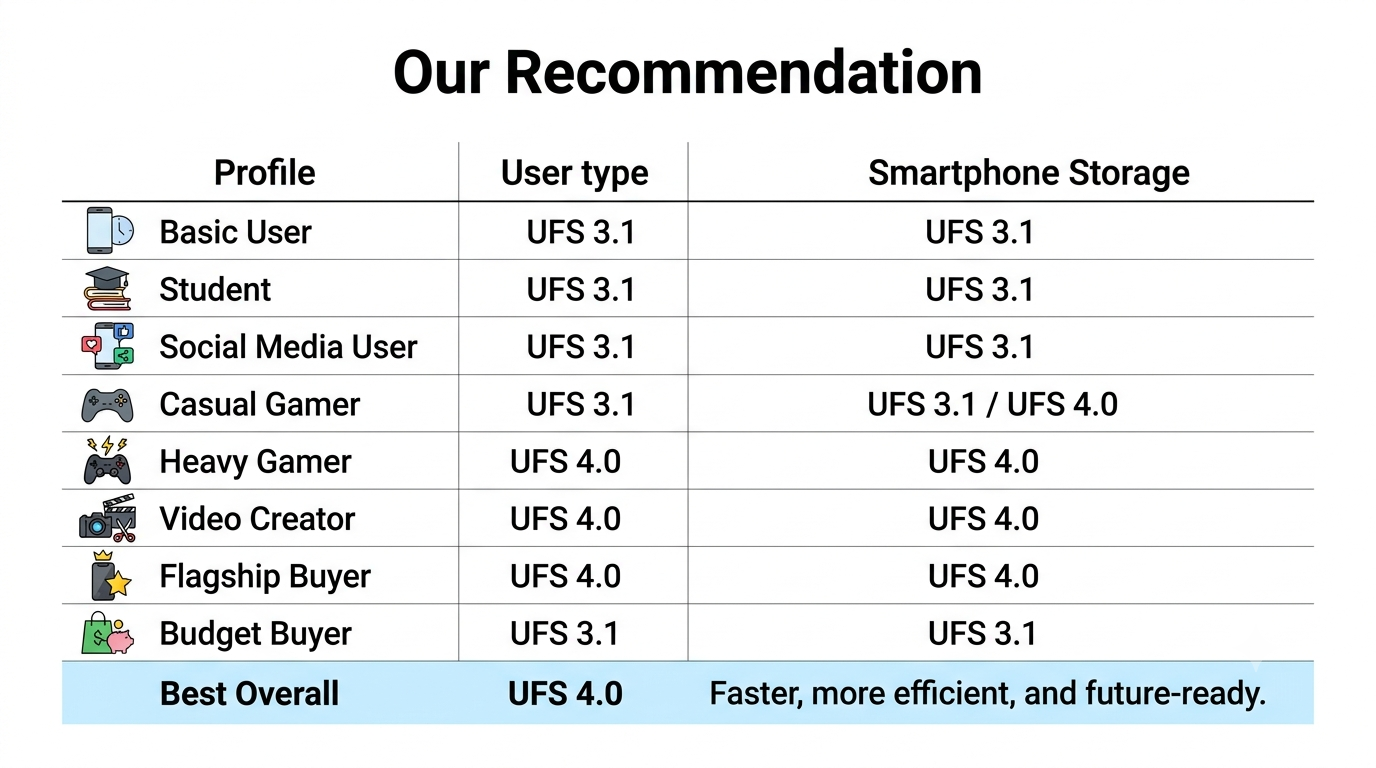
Who Should Choose UFS 4.0?
UFS 4.0 makes the most sense for:
• 🎮 Heavy mobile gamers
• 🎥 Video creators
• 📸 Photography enthusiasts
• 🚀 Heavy smartphone users
• 👑 Flagship smartphone buyers
• Users who frequently transfer large files
These users are more likely to benefit from faster storage.
Who Can Choose UFS 3.1?
UFS 3.1 is still a good option for:
• Students
• Casual users
• Social media users
• Regular photographers
• Budget buyers
• People who don't transfer large files frequently
For these users, spending extra for UFS 4.0 may not provide a noticeable improvement in everyday use.
UFS 3.1 vs UFS 4.0: Final Verdict
So, which one is better?
UFS 4.0 is the clear winner technically.
It offers higher read and write performance and improved efficiency compared with UFS 3.1. Samsung's published specifications show just how significant the performance improvement can be.
But that doesn't mean UFS 3.1 is outdated or unusable.
For most everyday smartphone users, UFS 3.1 remains fast enough.
If you're buying a premium smartphone and the price difference is small, choose UFS 4.0.
If you're buying a budget or mid-range smartphone, don't reject a good phone simply because it uses UFS 3.1.
Our recommendation
The Bottom Line
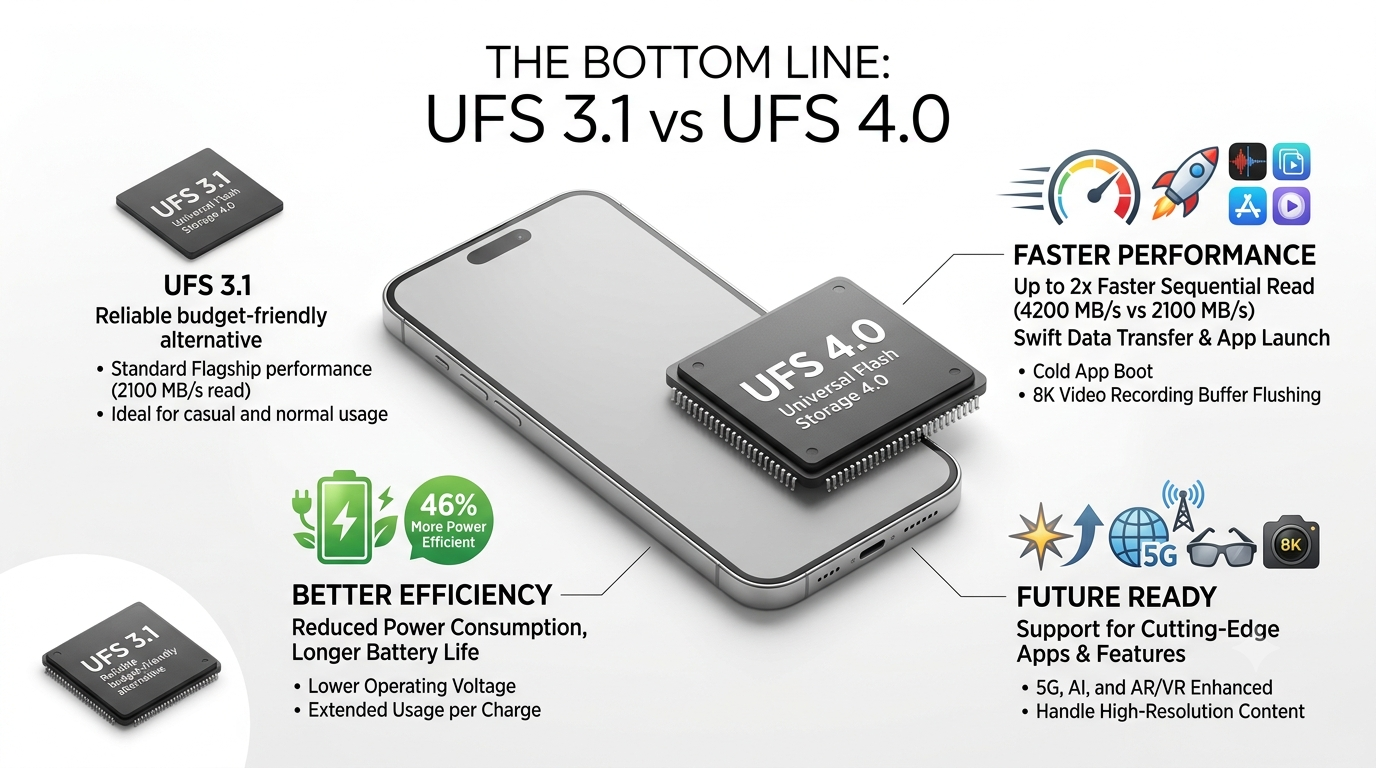
UFS 4.0 is faster and more efficient, but UFS 3.1 is still perfectly capable for everyday smartphone use in 2026.
If both phones are similarly priced, go with UFS 4.0. If choosing UFS 3.1 gives you a better processor, more storage or a better camera, don't hesitate to choose UFS 3.1.
The best smartphone isn't the one with the highest specification on paper. It's the one that offers the best balance of performance, storage, battery, camera, display and price.